Modernize Studio
Language: EN
Email us

Custom business software, integrations and data migration

Not every project starts from an old program. Some start from a process that runs on email and spreadsheets, from two systems that do not talk to each other, or from a database that has to move. We build the software, connect the systems, move the data and look after the result once it is live.

What we do

Custom business software

Web applications built around the way your company works: orders, stock, appointments, quotes, job tracking, internal approvals. We start from the documents and spreadsheets you use today, because they already describe the process in detail.

  • Roles and permissions per user, with a record of changes
  • Documents produced as PDF, with your own numbering
  • Your existing lists imported from Excel or CSV
  • C# with ASP.NET Core or PHP with MySQL, depending on who will maintain it
Integrations and APIs

We connect your applications to each other and to outside services through REST APIs, webhooks or scheduled file exchanges, so that data entered once reaches every system that needs it.

  • Links between management software, online shop, CRM and accounting package
  • APIs that let partners or your own tools read and write data in your application
  • Scheduled imports and exports in CSV, XML or JSON
  • A log of every exchange, with an alert when one fails

Data migration

We move data from Access, Excel, Paradox, dBase or an older database to SQL Server, MySQL or another SQL database, and before the switch we show you that nothing was lost or altered.

  • A mapping of every field, with conversions agreed in writing
  • Trial runs on a copy before the final transfer
  • A reconciliation report with record counts and totals, table by table
  • A list of the anomalies found, for you to decide on

Maintenance and support

Once an application is live, we look after it for a monthly fee agreed in advance. What the fee covers is written down before maintenance starts.

  • Fixes and small changes, requested by email
  • Security updates to the framework and libraries
  • Monitoring of errors and scheduled jobs
  • Checks that backups can actually be restored

How a project works

  1. A short written description

    Tell us what the software should do, which systems or data are involved and who will use it. Existing spreadsheets, forms or screenshots help more than a long specification.

  2. Proposal with a fixed price

    We reply in writing with the scope, the technology, a timeline and a fixed price. If something is unclear, we ask in writing before quoting.

  3. First module on your data

    We build one part first, usually the one people will use most, and your staff work with it before the rest is built. For an integration or a data migration, this is a trial run on a copy.

  4. Delivery in stages

    The rest follows in agreed stages, each one tested before it goes live. We use common technologies and document what we build, so you are not tied to us. Maintenance is available for a monthly fee agreed in advance.

What tends to go wrong, and how we prevent it

  1. Rules that live in people's heads

    The rules that matter most are often the exceptions: the customer who pays at 90 days, the product that is never discounted. We ask for real examples and past documents, and we write each rule down for you to confirm before building it.

  2. Integrations that fail without anyone noticing

    A call that times out or a file that arrives half-written can leave two systems out of step for weeks. Every exchange we build is logged, retried when that is safe, and reported when it fails.

  3. Two systems, two versions of the same customer

    Systems rarely agree on how a customer or a product is identified. Before connecting them, we agree with you which system owns each piece of data and how records are matched.

  4. A data migration nobody can check

    Copying tables is rarely the hard part. The work lies in showing that every record arrived unchanged. We run the migration on a copy first and deliver a reconciliation report, so the final switch repeats something that has already been verified.

  5. Software nobody else can maintain

    We use widely known technologies, C# with ASP.NET Core or PHP with MySQL, and document what we build, so your IT provider or another developer can take over without starting again.

Price and payment

Proposal

Fixed price

in writing, before work starts

Maintenance

Monthly fee

agreed in advance

Every proposal states a fixed price for the work described in it.

Maintenance is billed as a monthly fee, agreed in writing before it starts.

Prices are fixed and agreed in writing before work starts. If the scope changes, we send a new written quote and wait for your approval before doing the extra work.

Prices exclude VAT.

A real migration, checked by tests

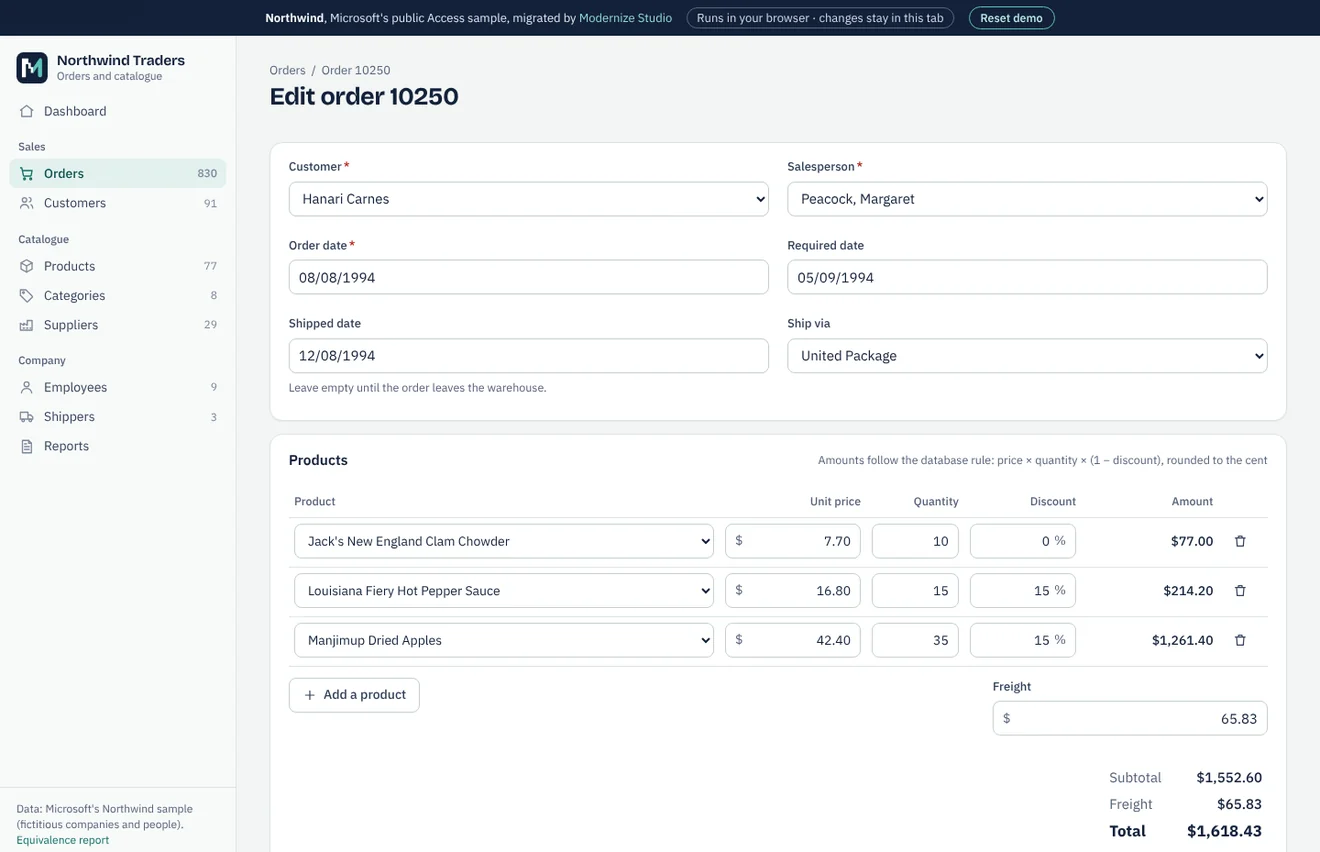
Northwind is the sample database Microsoft shipped with Access, not a client of ours. We migrated a public copy to SQLite and PostgreSQL, compared every table and every query with the original through automated tests, and built a working web application on the result. The case study gives the figures and the equivalence report lists every check.

The case study is a migration, but new projects are tested and documented in the same way.

Equivalence report · Clickable preview and sample assessment (demo)

FAQ

How do we get a price for a new application?

Send us a short written description. We reply with a proposal, a timeline and a fixed price. If we need more information, we ask in writing.

Can you connect our software to a system that has no API?

Often, yes: through scheduled file exports, direct access to its database where that is allowed, or the import functions it already offers. The proposal states which method we would use and what its limits are.

Do you work on applications you did not build?

Yes, for integrations, data migrations and maintenance. We start by reviewing the existing code and data in writing, so the price is based on what we actually find.

What does maintenance cost?

A monthly fee agreed in advance, based on the size of the application and the amount of change you expect. It is set out in writing before maintenance begins.

Can a data migration happen without stopping work?

Yes. We run trial migrations on copies while you keep working, then the final transfer at a time you choose, usually outside working hours, followed by the reconciliation report on the final data.

Which technologies do you use?

Mainly C# with ASP.NET Core, or PHP with MySQL, plus JavaScript in the browser, SQL databases such as SQL Server and MySQL, and REST APIs for integrations. We choose based on what your team or your IT provider can maintain afterwards.

Contact

By email:

riccardo@modernizestudio.com
Write an email

Send us a short description of the project, with any spreadsheets or screenshots that help explain it. We reply within one working day.

We work from Italy.

Email us